


Akebia quinata ‘Shirobana’

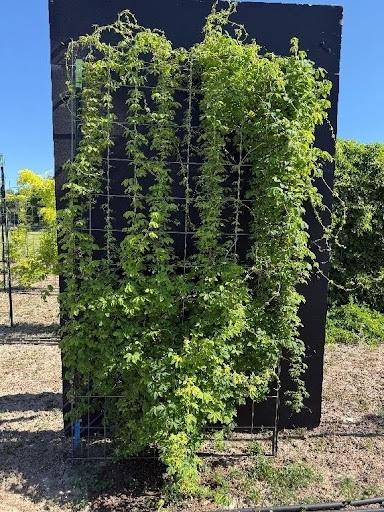
Akebia quinata ‘Shirobana’ at USU in 2025. Photo: S. Burlakoti
Summary
Akebia quinata ‘Shirobana’, commonly known as White flowered chocolate vine, is a vigorous, twining woody vine in the family Lardizabalaceae, native to China, Japan, and Korea. Introduced to the United States in 1845 as an ornamental plant, it has since naturalized in parts of the eastern U.S., particularly in warmer climates. The species is hardy in USDA zones 5–9 and exhibits variable foliage behavior depending on climate, remaining semi-evergreen to evergreen in warmer regions while becoming fully deciduous in cooler climates. This fast-growing vine can reach 20–40 feet in length and is prized for its attractive, palmately compound foliage. Each leaf is typically composed of five elliptic to oblong leaflets (1–3 inches long) that radiate from a central point. The leaflets are dark green above, with a slightly glaucous underside, and often display a purplish tinge when young before maturing to a blue-green color. Stems are green in youth, turning brown with age.
In early spring, fragrant, chocolate-purple flowers emerge in drooping axillary racemes. Although the blooms are approximately one inch across and pleasantly scented, they are often partially obscured by the foliage. As flowers develop on old wood, pruning should be done immediately after flowering to avoid sacrificing the following season's blooms. White flowered chocolate vine grows well in ordinary, well-drained soils and performs best in full sun, though it tolerates deep shade. It is broadly adaptable, showing resilience to drought, wet sites, deer browsing, erosion, and heavy shade. However, its rapid and aggressive growth habit means it can readily overtake surrounding shrubs and vegetation if not kept in check through regular pruning. In the landscape, it is most commonly used as a fast-growing cover for arbors, trellises, and fences, though its growth rate may be somewhat reduced in colder regions.
Growth of White flowered chocolate vine was moderate across irrigation treatments, with plants showing strong vining behavior and rapid seasonal development. Trellis coverage increased steadily during the growing season, although only a few plants fully covered the 8-ft trellis by the end of the 2025 growing season. Plants generally climbed well and attached properly to the trellis without requiring pruning. Foliage quality and overall appearance were generally good across treatments, which was also reflected in the 2025 open house ratings, where visitors evaluated overall plant appearance on a 1–5 scale relative to other plants on display (3.80 for 80% ETo, 3.55 for 50% ETo, and 3.53 for 20% ETo). Flowering was only observed in a few species throughout the growing season. Plant survival was relatively high, although eight plants died during the winter period, suggesting moderate cold tolerance. Overall survival was 83.3% in 2024 but decreased slightly to 70.8% in 2025. Overall, White flowered chocolate vine performed well under reduced irrigation and demonstrated high drought tolerance, although winter injury may limit long-term performance in colder climates. However, the growth rate was slower compared to other vine species, which may be a concern when rapid trellis coverage or screening is desired.
Basic Info
| Site(s): | USU - Logan, UT |
| Trial Exposure: | Full Sun |
| Year evaluated: | 2025 |
| Reported Height & Width: | 15-20’ x 6-9’ |
| Trellis coverage (after 2 years): | 61% |
| Irrigation recommendation: | High |
Mean Overall Appearance rating: (1-5 Scale, 5 is highest) | 2.9 |
Growth and Quality Data
Click Here for Complete Data Set
Akebia quinata ‘Shirobana’ at USU in 2025. Photo: S. Burlakoti