


Climate Ready Vines
Traditionally, trees have been used to shade and cool buildings. However, trees can take many years to grow to a size that is effective in providing these services. Few vine species have been studied for their ability to mitigate solar loads onto buildings thereby reducing the surface temperatures of walls. Vines on trellises have the potential to render similar cooling effects and can grow at a much faster rate than trees. However, a rigorous evaluation that compares the performance of a large number of vines taxa has not been conducted. This project seeks to demonstrate the growth rates and water needs of different vines and the impact of these variables on the ability to reduce temperature around structures in the various climates across the Western US.
This is a multi-state collaborative research effort to evaluate and monitor cooling effects, water use, and horticultural characteristics of vine plants across different climates and latitudes. The project utilized the Climate Ready Plants network to evaluate vines at five study sites located in the western U.S. states of Arizona, California (2 sites), Utah, and Washington. The project seeks to generate data, knowledge, and information needed to support growers and consumers in identifying vine taxa that are suitable for their climate.
Trial Site Locations
- Davis, California - UC Davis (UCD)
- Irvine, California - South Coast Research & Extension Center (SCREC)
- Logan, Utah - Utah State University (USU)
- Seattle, Washington - University of Washington (UW)
- Tucson, Arizona - University of Arizona (UA)
Vines Trialed
While full results are pending, selected results have been formatted into brief, easy to read scorecards to provide an at-a-glance overview of how the plants performed during the trial.
Click here to view a list of all species evaluated & their locations (pending) | Click here to view all the scorecards (PDF)

Hardy kiwi vine
Actinidia arguta ‘Issai’
Self-fertile, produces edible green fruits in late summer - early fall
Scorecard (PDF) | Results

Madame Galen trumpet vine
Campsis × tagliabuana ‘Madame Galen’
Grow it for the attractive red-orange tubular flowers popular with hummingbirds
Scorecard (PDF)

Climbing hydrangea
Hydrangea anomala subsp. petiolaris
Attractive foliage, fragrant flowers, well-suited for shaded areas with low maintenance needs
Scorecard (PDF)

Potato vine
Solanum jasminoides
Abundant, snowy white flowers and lush foliage during blooming season
Scorecard (PDF)

Amethyst Falls American Wisteria
Wisteria frutescens ‘Amethyst Falls’
Attractive fragrant flowers, silvery-colored new growth and a slow-growing habit
Scorecard (PDF)

White flowered chocolate vine
Akebia quinata ‘Shirobana’
Fragrant white dangling spring flowers, attractive palmate foliage, and vigorous climbing vine
Scorecard (PDF)

Princess Diana clematis
Clematis texensis ‘Princess Diana’
Attractive, long-lasting flowers with good trellis coverage and relatively low maintenance
Scorecard (PDF)

Goldflame honeysuckle
Lonicera × heckrotti ‘Goldflame’
Pink and yellow flowers waft scent into the landscape and are visited by hummingbirds
Scorecard (PDF)

Star jasmine
Trachelospermum jasminoides
Easy to maintain vine with fragrant dense blooms that brighten up a landscape
Scorecard (PDF)

Yellow orchid vine
Callaeum macropterum
Showy yellow orchid-like flowers spring through summer, winged butterfly shaped chartreuse fruits
Scorecard (PDF)

Yellow jessamine
Gelsemium sempervirens
Solid evergreen backdrop, yellow flowers herald arrival of spring
Scorecard (PDF)
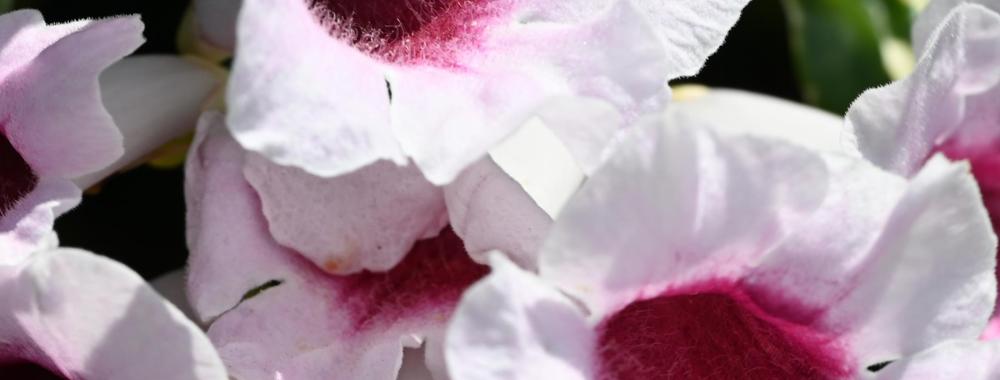
Variegated bower vine
Pandorea jasminoides ‘Variegata’
Lush foliage; vibrant flowers attract pollinators; pest & disease resistant
Scorecard (PDF)

Virginia creeper
Parthenocissus quinquefolia
Fiery red fall foliage, inconspicuous flowers popular with pollinators, and fruit for birds
Scorecard (PDF)

Roger’s Red California grape
Vitis × ‘Roger’s Red’
Attractive green canopy turning fiery red in fall, fruit mostly for wildlife (we made jam!)
Scorecard (PDF)

Balboa Sunset trumpet vine
Campsis radicans ‘Monbal’
Vigorous grower, covers trellis quickly, showy trumpet-shaped flowers attract pollinators
Scorecard (PDF)

Purple lilac vine
Hardenbergia violacea
Vibrant purple blooms that attract pollinators and provide early season interest
Scorecard (PDF)
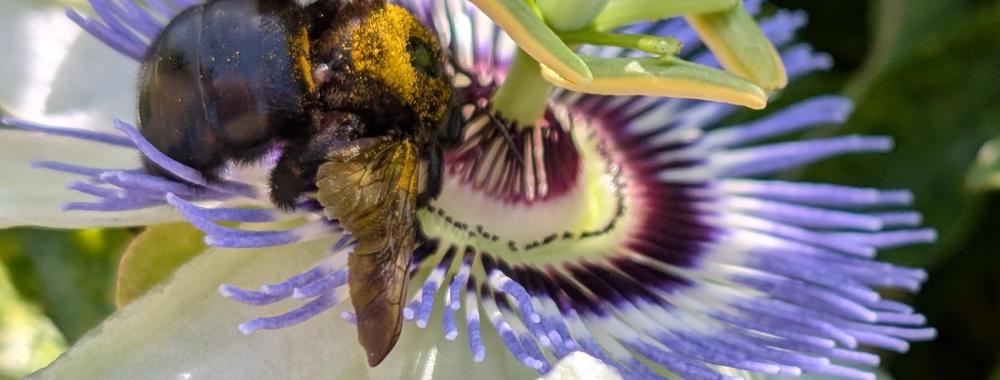
Blue passionflower
Passiflora caerulea
Reliably produces eye catching flowers that attract bees and yield bright orange fruits
Scorecard (PDF)
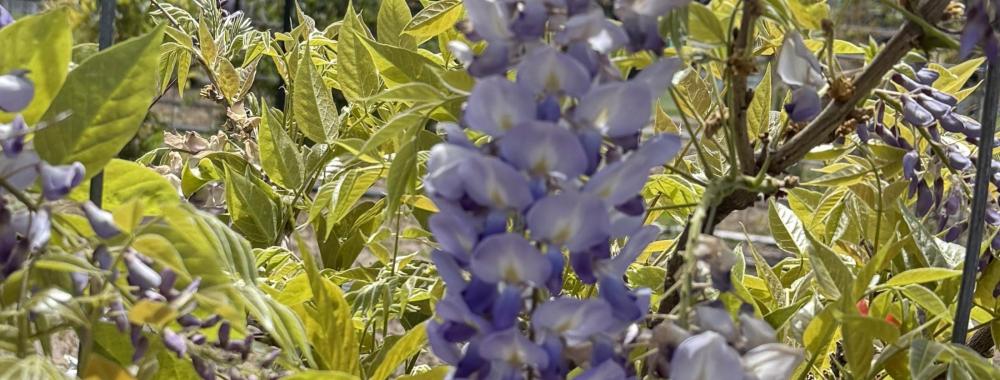
Texas Purple Japanese wisteria
Wisteria floribunda ‘Texas Purple’
Showy cascading purple flowers, striking spring display, and popular with pollinators
Scorecard (PDF)